Lessons from Confcrypt
Structuring Functional Programs
Agenda
- Anti-Pattern
- Making Things Easier
- Extending The Program
Anti-Pattern
Tight Coupling, low Information Density
createUser :: ApiaryC c =>
    Bool
    -> NewUserData
    -> ReaderT c (ExceptT AppError (LoggingT IO)) User
createUser sendPasswordSet dta = do
    $(logDebug) $ "Creating new user " <> tShow dta
    P.guardEmailAvailable (newUserEmail dta)
    maybe (pure ()) P.guardPhoneAvailable (newUserPhone dta)
    usr <- P.createUser dta
    when sendPasswordSet (genAndSendInitialPasswordSet usr)
    pure usr
Easy to write though...
Anti-Pattern
What does this signature tell you about the function?
ApairyC c =>
    Bool
    -> NewUserData
    -> ReaderT c (ExceptT Err (LoggingT IO)) Foo
Capabilities?
What can't it do?
What about errors?
Function Capabilities
As APIs
- Guides implementations
- Easy extensibility
- Testing via mocks/ pure implementations
- Improves readability
Function Capabilities
An Example
type ConfCryptM m ctx = ReaderT (ConfCryptFile, ctx) (
    ExceptT ConfCryptError (
        ResourceT m))

class (Monad m, MonadError ConfCryptError m) =>
    MonadDecrypt m k where
    decryptValue :: k -> T.Text -> m T.Text

class Monad m => Command a m where
    evaluate :: a -> m [Text]

data ReadConfCrypt = ReadConfCrypt
instance (Monad m, MonadDecrypt (ConfCryptM m key) key) =>
    Command ReadConfCrypt (ConfCryptM m key) where
Function Capabilities
Guiding our Implementation...
runConfCrypt ::
    ConfCryptFile
    -> ConfCryptM IO () a
    -> IO (Either ConfCryptError [T.Text])

case parsedArguments of ->
    RC KeyAndConf {key, provider} ->
        runConfCrypt parsedConfiguration $
            runWithDecrypt key provider ReadConfCrypt
Extending The Program
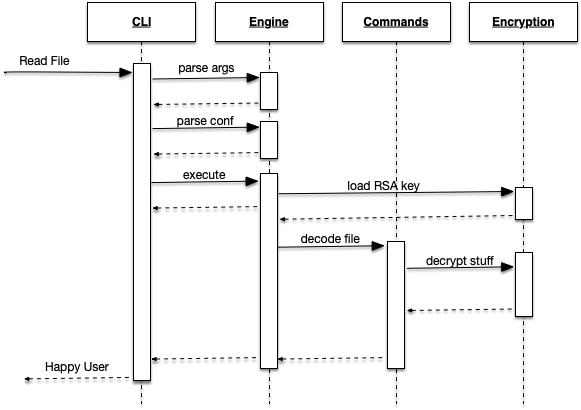
Initial RSA Algorithm
Extending The Program
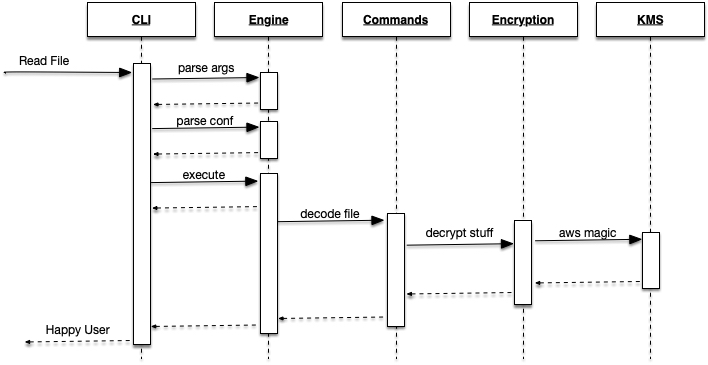
Oh no, KMS Support??!!